
Latest
News
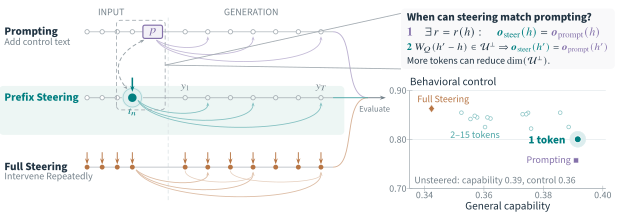
- Oct 2026 Released One Token Can Be Enough on arXiv: steering an LLM’s activations only briefly at the start of generation, even for a single token, often keeps much of full steering’s control while better preserving general capabilities.
- 2026 Received the MMLS 2026 Travel Award from the Midwest Machine Learning Symposium.
- Jan 2026 AbsTopK, on sparse autoencoders for bidirectional features, was accepted to ICLR 2026.
- Jun 2025 Released From Emergence to Control, on probing and steering self-reflection in LLMs.
- 2024 Started my Ph.D. at The Ohio State University, advised by Prof. Zhihui Zhu.
- 2024 FCDS was published at LREC-COLING 2024.
Peer-reviewed work
Publications
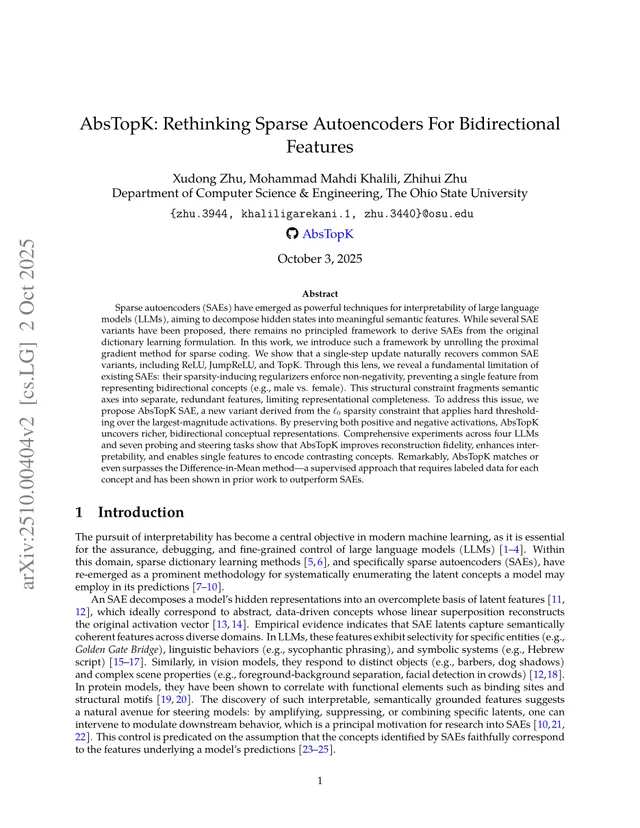
ICLR 2026
AbsTopK: Rethinking Sparse Autoencoders For Bidirectional Features
Sparse autoencoders (SAEs) are widely used for LLM interpretability, but existing variants often impose non-negativity that prevents single features from representing bidirectional concepts. We derive SAE variants from unrolled proximal gradient updates, identify this structural limitation, and propose AbsTopK SAE with magnitude-based hard thresholding. Across four LLMs and seven probing/steering tasks, AbsTopK improves reconstruction and interpretability while enabling single features to encode contrasting concepts.
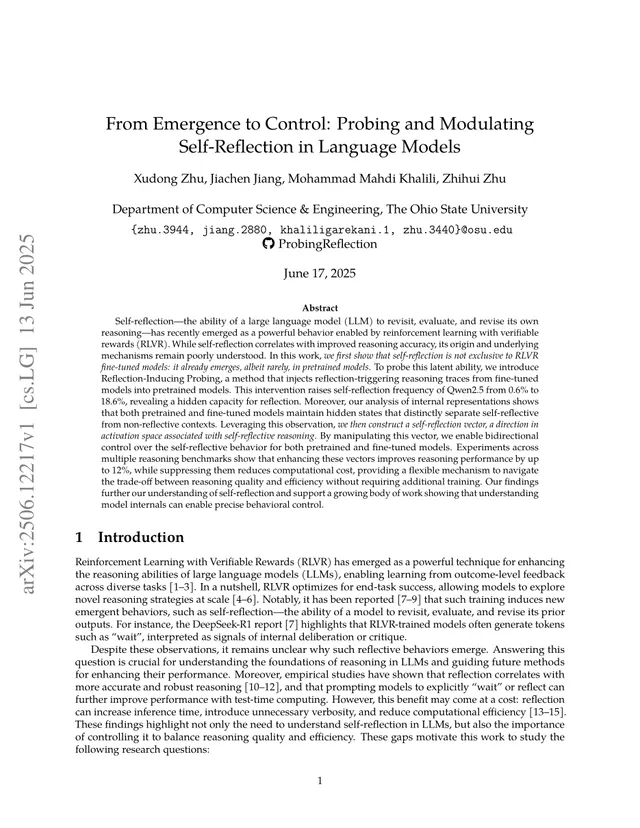
TMLR 2026
From Emergence to Control: Probing and Modulating Self-Reflection in Language Models
We study the emergence and control of self-reflection in large language models. Our probing method reveals that pretrained models already contain a latent capacity for reflection, which can be amplified without additional training. By identifying and manipulating a “self-reflection vector” in activation space, we achieve bidirectional control over reflective behavior, improving reasoning accuracy or reducing computation as needed. This work deepens understanding of self-reflection and demonstrates how model internals can enable precise behavioral modulation.
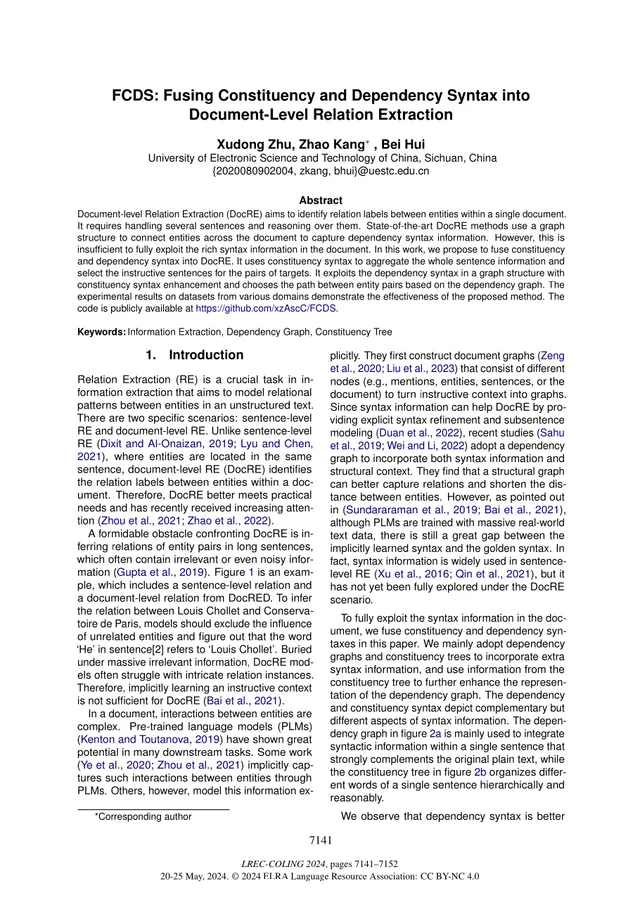
LREC-COLING 2024
FCDS: Fusing Constituency and Dependency Syntax into Document-Level Relation Extraction
We introduce FCDS, a document-level relation extraction model that fuses constituency and dependency syntax. By combining sentence-level aggregation from constituency trees with dependency-based graph reasoning, FCDS better captures cross-sentence relations between entities. Experiments across multiple domains show significant performance gains, highlighting the effectiveness of integrating both syntactic views.
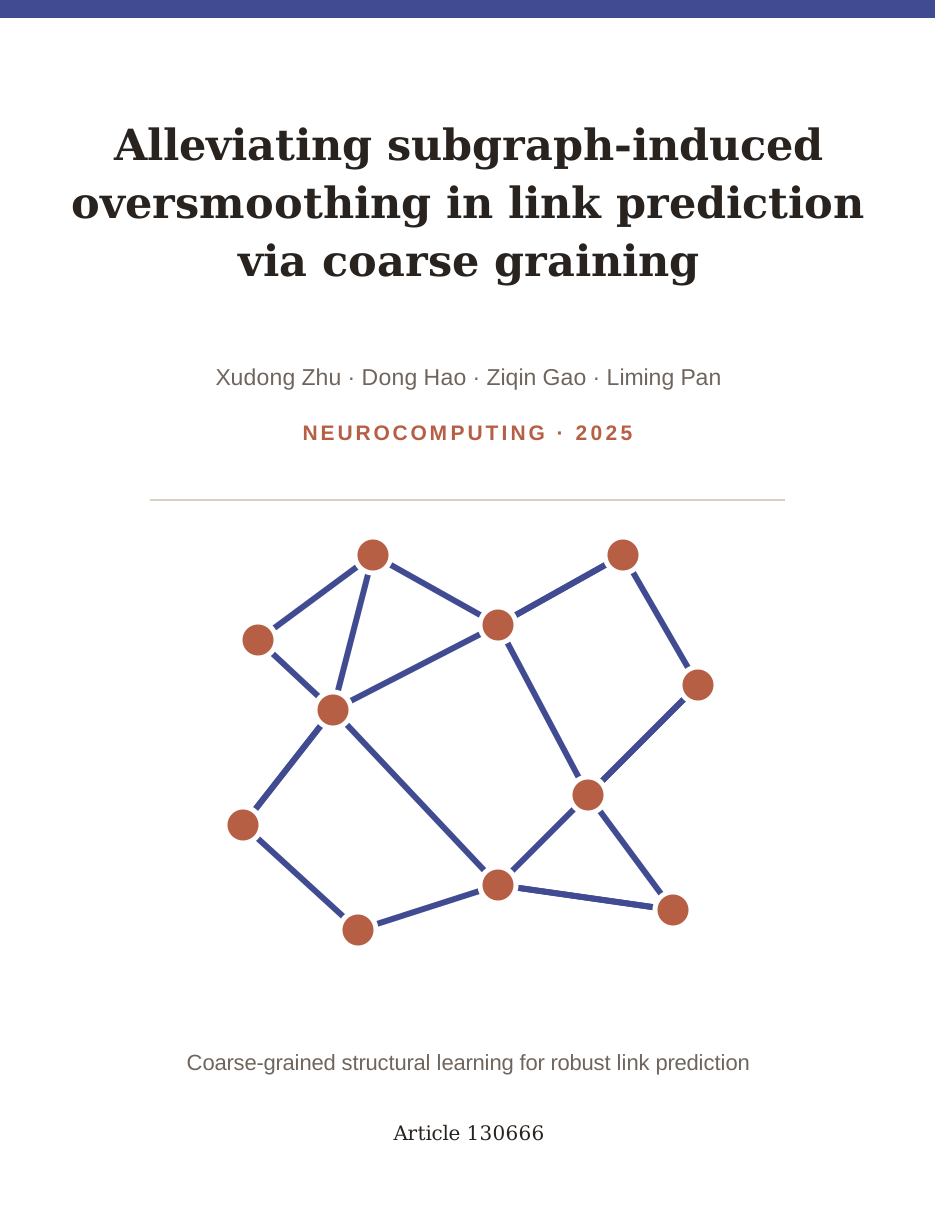
Neurocomputing, 2025
Alleviating subgraph-induced oversmoothing in link prediction via coarse graining
We address the oversmoothing problem in link prediction caused by repetitive high-degree nodes across subgraphs. Our method introduces a coarse-graining strategy that merges strongly correlated nodes, yielding more diverse receptive fields and reducing subgraph size. This not only mitigates oversmoothing but also improves scalability and efficiency of GNN-based link prediction.
Working papers
Preprints & Working Papers
arXiv preprint
One Token Can Be Enough: Bridging Prompting and Activation Steering with Prefix Steering
Bridging prompting and activation steering, short initial interventions often retain much of full steering’s behavioral control while better preserving general capabilities.
Notes & essays
Writing
Research Templates, Part 1: Papers and Project Pages
A paper template and a project page, built around the details I want to reuse across research projects.
Selected repositories
Building in Public
Academic path
Education
Present
Ph.D. in Computer Science and Engineering